A collection of resources, programs, and advice for cardiothoracic surgeons in their first seven years of practice.

This Latin Heart Rounds collaboration between the Society of Thoracic Surgeons and the American College of Cardiology (ACC) will feature an international panel of cardiologists and cardiac surgeons from Latin America, Europe, and the United States speaking about the current management of syndromic aortic disease. The panel will discuss:  

Date
1 p.m. ET

During this webinar, an expert panel will focus on different methods of cannulation including: open vs. percutaneous cannulation; perfusion strategies (including when bicaval cannulation is needed); and examination of different methods of myocardial protection including transthoracic aortic cross-clamping and endo-balloon. The session is relevant for cardiac surgeons and trainees at all experience levels, as well as members of robotic cardiac teams interested in understanding basic techniques relevant to robotic cardiac surgery and advanced methods used in more complex scenarios.  

Date
7 p.m. ET
Demystify the Oral Board Exam with STS Prep
Event dates
Apr 1 – May 31, 2026
Location
Virtual
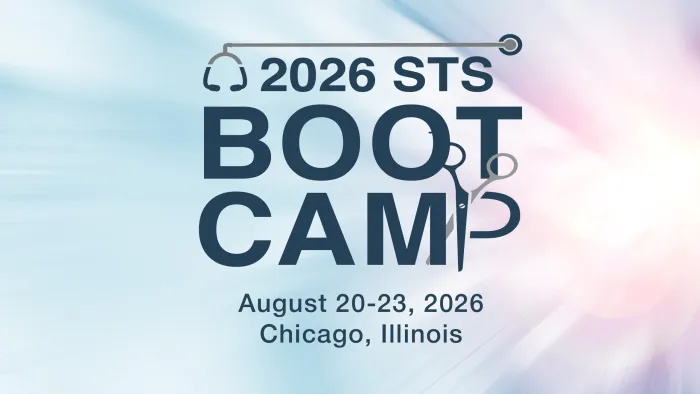
An experiential foundation and hands-on practice in basic cardiothoracic operating skills for first-year residents.
Event dates
Aug 20–23, 2026
Location
Chicago, IL

Please

Date
8 a.m. ET
Duration
1 hr. 24 mins.
Join a live discussion on building the foundation of a strong career.
Event dates
Dec 9, 2025
Location
Virtual

The STS You Belong Scholarship program is a workforce development program that provides mentorship and exposure to CT surgery for medical students and general surgery residents from unique backgrounds. Applicants are encouraged to pursue careers in cardiothoracic surgery and successfully match into thoracic integrated residency and fellowship programs.

Applications have closed. Recipients will be notified in December. 


The Society of Thoracic Surgeons hosted an early career webinar, How to Maximize Your First Six Months of Training, facilitated by Sandeep Bharadwaj, MD, Northwestern University, and featuring insights from faculty, fellows, and recent graduates, including Sara Pereira, MD, Indiana University School of Medicine; Irbaz Hameed, MD, Yale University School of Medicine; Allison Davila, MD, Lurie Children’s Hospital of Chicago; Kathleen Banfield, MD, University of Washington; and Rachel Schenkel, MD, University of Minnesota. The session focused on how residents and fellows can set themselves up for success during the critical early months of cardiothoracic surgery training.

Here are the five key takeaways:

1. Preparation and Attention to Detail Build Trust

Panelists emphasized that preparation begins with knowing the patient thoroughly through indications, imaging, labs, and prior operative notes. Because each attending has different preferences, keeping a running document of techniques and nuances is invaluable. Remembering even small details, such as how a surgeon places retraction stitches, signals meticulousness and builds early trust.

Tip: Take notes or create personalized preference cards after each case. Reviewing them before scrubbing in demonstrates initiative and reliability.

Panelists also talked about the importance of using medical journals and resources strategically. For example, the Annals of Thoracic Surgery was highlighted as the most commonly read journal, with additional helpful content sometimes found in cardiology-focused publications such as Circulation or JACC. Apps like the older CSAT versions can also be valuable if still available.

2. Maximize Rotations Beyond the Operating Room

Early in training, residents should take advantage of rotations in anesthesia, perfusion, and imaging. These experiences provide foundational knowledge about cardiopulmonary bypass, echocardiography, and perioperative care that will make OR time more meaningful later.

Advice from faculty: “You’ll have plenty of opportunities for cardiac and thoracic cases. Early on, prioritize learning the physiology, imaging, and team dynamics that support those operations.”

3. Presence Matters More Than Case Volume

Technical milestones in the first six months vary widely and depend largely on faculty trust. Rather than focusing on how many sternotomies or cannulations you log, concentrate on showing up prepared and present. Double-scrubbing, even when you’re not the primary, provides an opportunity to observe technique, communication, and decision-making without the pressure of leading the case. 

Key reminder: “It isn’t always about doing, it’s about being present and understanding the flow of the operation.”

4. Clarify Communications, Manage Expectations, and Avoid Comparisons

Many trainees struggle with self-doubt when their technical skills don’t advance as quickly as their peers’ skills. Faculty urged residents not to compare themselves to others or to what’s portrayed on social media. Everyone progresses at a different pace, and impostor syndrome is common. Define communications protocols. Different institutions use pagers, texts, WhatsApp, Epic chat, or Teams messages. Trainees should learn the preferred hierarchy of communication (e.g., page - call vs. text - call) and align with their team’s expectations. Junior residents are also encouraged to err on the side of overcommunication with seniors and attendings. If you’re unsure whether to call, the safe rule is that you should.

Practical step: Check in regularly with program directors or attendings. Structured feedback often reveals that you’re performing at or above expectations, even if you feel behind.

5. Develop a Study System That Works for You

Learning outside the OR is just as important as time inside it. Some panelists recommended structured reading plans, such as committing to one textbook in the first year, while others suggested journaling surgical techniques or building photo libraries of operative steps. The method matters less than consistency.
Advice from the panel: Identify a study routine early and stick to it, whether through textbooks, operative atlases, or case-based reviews. Over time, selective reading and case preparation will sharpen your clinical judgment.

The first six months of cardiothoracic surgery training are about more than technical skills. They are about building trust, cultivating presence, and laying the foundation for a lifelong career. By preparing thoroughly, engaging fully in every rotation, and giving themselves grace, residents can maximize this critical period.


Sep 22, 2025
3 min read

This latest episode of Thinking Thoracic, an STS podcast, features host Erin Gillaspie, MD, in conversation with Jonathan Spicer, MD, a leading thoracic oncologist and clinical trial investigator. The two dive into the landmark CheckMate 816 trial, which helped usher in a new era for immunotherapy in lung cancer treatment. Dr. Spicer shares insights on trial design, clinical outcomes, and what these findings mean for the future of thoracic surgery and oncology. Listen today.

1 hr